


Building Smart Semantic Search using PostgreSQL and pgvector. Part 3 - Hybrid Search, Percona Blog, and Widget Improvements
Here I write about what I changed after the first launch: hybrid search, filters and counts on the search page, the widget layout, indexer hardening, and the Percona Blog in the index. People often type short words or names, and pure vector search is weak at that. When I turned search on about a month ago I asked for feedback in Part 1, and most of what follows came from that.
Part 1 is the introduction and stack overview. Part 2 is Postgres, chunks, SQL, and the indexer.

A month in production
The API and indexer run in Docker on EC2. The engine is PostgreSQL with pgvector. On the site there is a search widget in the blog header and a full results page at percona.community/search/. Both call the same API. Search has been up since launch. I log queries for debugging and picked up feedback from colleagues, mostly in conversation and from my own tests, not from an analytics dashboard.
I keep search_history in Postgres as an engineering log: timings, regressions after hybrid changes, vector vs keyword splits. To be honest, the first month is mostly my smoke tests. Lots of test, the same names repeated while I debugged person-search, random widget checks. A “top user queries” chart from that log would look like internal QA, not real audience insight, so I am not publishing one here.
From feedback and from what I tried by hand, three kinds of queries kept showing up.
Short ones are a single product token (pgbackrest, timescaledb) or a person’s name (contributor or Percona Blog author). Long phrases like “zero downtime database migration” or “replication lag troubleshooting” still work fine with vector-only search, as in parts 1 and 2. People also want filters by content type and honest counts on the tabs, so it does not feel broken when the UI shows 30 cards but the tab says 900 matched.
That shaped what I worked on in June. The table below is illustrative, not a leaderboard from production logs.
| Example query | Type | Why it matters |
|---|---|---|
timescaledb | keyword | one word, weak vector, needs text |
PMM | keyword | short product name |
Peter Zaitsev | person | contributor profile plus author articles |
slow queries mysql | hybrid | short tech phrase, not pure semantics |
zero downtime database migration | semantic | long query as designed |
In /demo under History I left the log and the Word statistics tab for myself. When traffic grows and I filter out test noise, that view will be more useful.
Widget and the search page
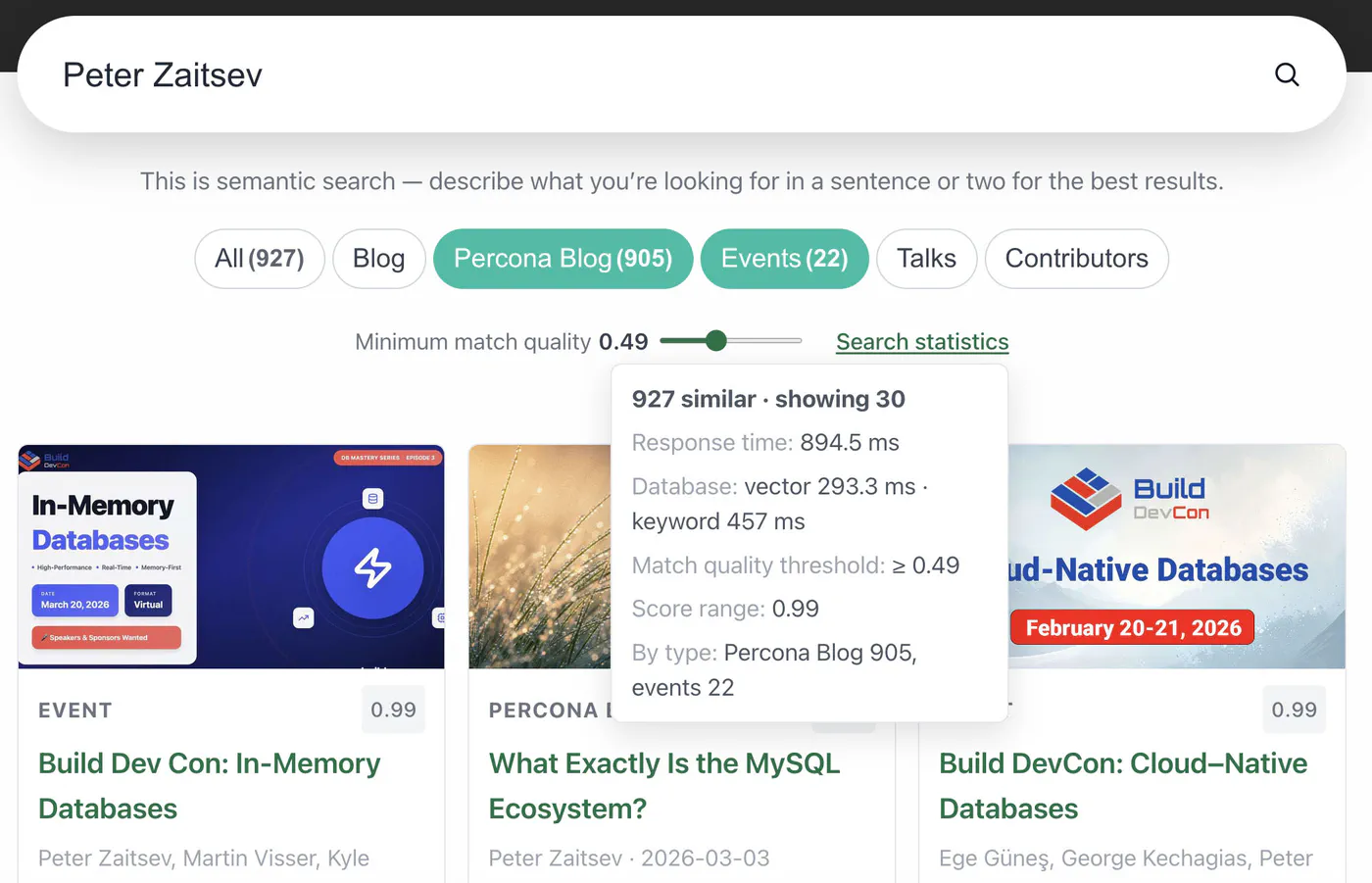
The widget has two modes, the popup in the header and the full /search/ page (see the screenshot at the top of the post for tabs, counts, and the match quality slider).
From feedback I added filter tabs with multi-select (All, Blog, Percona Blog, Events, Talks, Contributors). The choice goes into the URL as ?type=blog,talk. Tabs show counts in parentheses. Without a query that is indexed totals from public GET /health. After a search it is match counts per type from a separate COUNT in the API, without loading every card. There is a “Minimum match quality” slider for min_score, saved in localStorage and the URL. Search statistics (timings, vector vs keyword, score range) sit behind a compact link instead of taking half the page. Cards on /search/ have a preview image, type, score, and a shorter excerpt.
I set the search page content width to 960px with tabs and controls centered. Small thing, but it reads better on mobile and desktop.
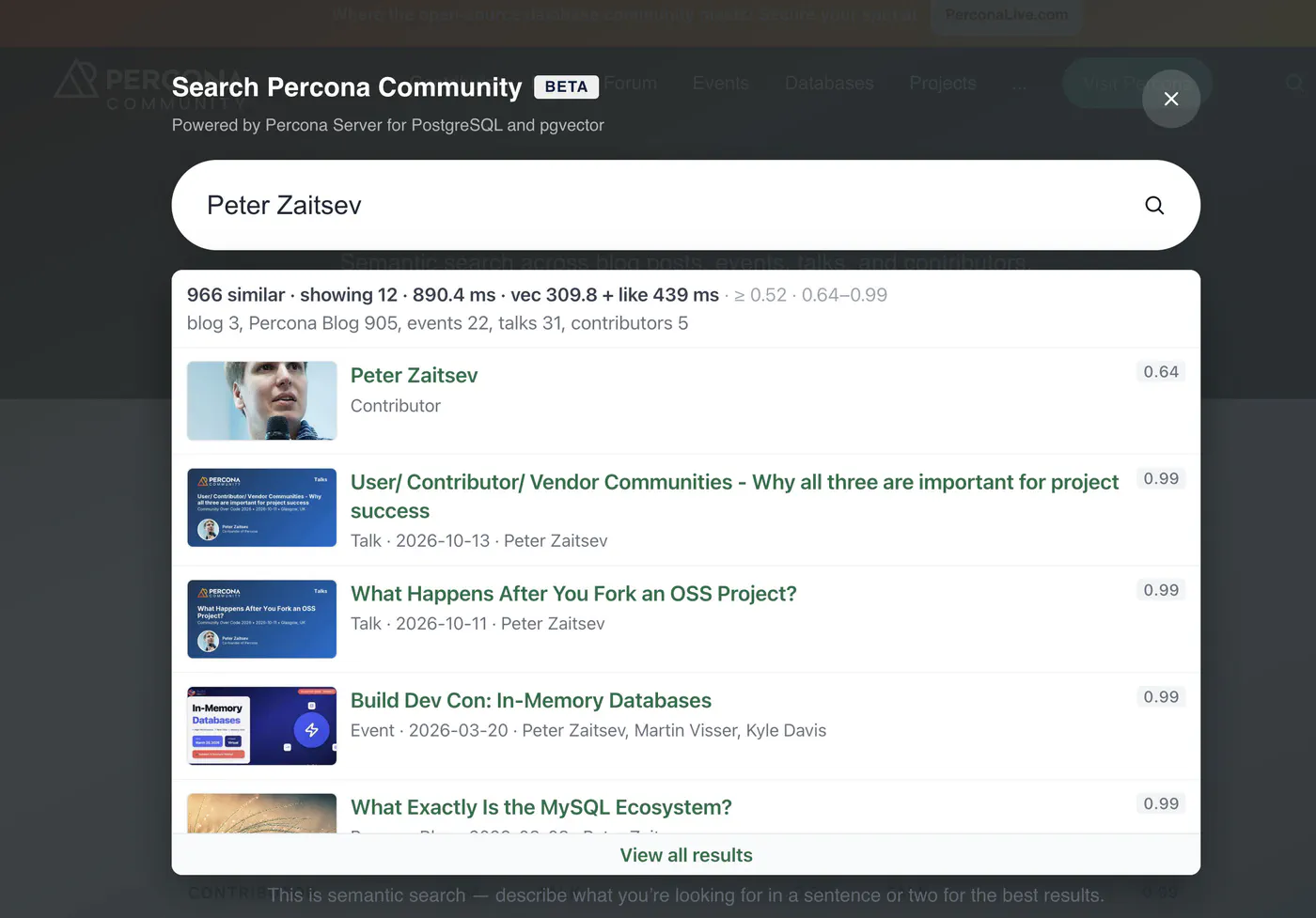
The next two screenshots use Peter Zaitsev as the person-search demo. -pz- in the filenames is shorthand for that query.
The popup in the site header uses the same API. Metadata stays compact above the results.
Why short queries hurt pure vector search
The embedding model is trained on phrases and context. A one-token query like pgbackrest or two words without a clear topic like Peter Zaitsev gives a short vector with a weak signal. In 768 dimensions many irrelevant chunks still land “not too far away”, especially across 18k chunks.
With Peter Zaitsev, vector search pulled random old posts that mention the name in the body. The contributor profile and recent author articles were not on top. With pgbackrest, semantics blurred and the top hits were “something about backup”, not necessarily pgBackRest.
A long query like “how to reduce replication lag on PostgreSQL” is a different story. Query and documents are rich in context and cosine similarity behaves predictably. For that I kept vector-only.
Hybrid search options
I needed a stronger keyword leg for short queries without breaking semantic search for long ones.
| Option | Pros | Cons / why not now |
|---|---|---|
PostgreSQL FTS (to_tsvector, ts_rank) | built-in, GIN indexes | dictionaries, stemming for names and brands |
pg_trgm | good for typos | heavier at scale, extra indexes |
| OpenSearch / Elasticsearch | mature BM25 | another cluster, I skipped this in Part 1 |
| ILIKE plus heuristic score | fast to ship, one Postgres, easy to debug | not full BM25, %pattern% without GIN slows down at huge scale |
I started with ILIKE as step one. Something to compare against, with a clear upgrade path to FTS, trigram, or RRF. At community scale, about 7k documents, it is acceptable for now.
How hybrid search works in the API
Query mode
detect_search_mode() in search_hybrid.py picks one of three modes.
keywordfor one token (timescaledb,audit_log)personfor 2-4 name-like tokens (Peter Zaitsev), with stop words likepercona,mysqlsemanticfor everything else, vector only
Two search legs
For keyword and person I run vector search as before (best chunk per document, score >= min_score, LIMIT N) and keyword SQL on pages, plus a chunk body check when needed:
WHERE p.author ILIKE '%Peter Zaitsev%' ESCAPE '\'
   OR p.title ILIKE '%Peter Zaitsev%' ESCAPE '\'
   OR p.description ILIKE '%Peter Zaitsev%' ESCAPE '\'
   OR … tags, chunk body …
ORDER BY
  CASE WHEN p.author ILIKE … THEN 0
       WHEN p.title ILIKE … THEN 1
       ELSE 2 END,
  p.date DESC NULLS LAST
For person I add ILIKE on each name part in author and title. Heuristic score 0.72-0.99 in Python (score_keyword_row). Exact author match ranks above a mention in the body.
ILIKE and user input. The SQL above uses literals for readability. In code every pattern is ILIKE %s ESCAPE '\\' and psycopg2 binds the value. The query string is never concatenated into SQL, so classic injection like ' OR 1=1 -- does not apply. Parameters alone are not enough for ILIKE because % and _ are wildcards inside the pattern. I escape \, %, and _ in Python, wrap the term in %…%, and set ESCAPE '\\' in SQL so a user cannot widen the match with their own %. Chunk body checks use POSITION(LOWER(%s) IN LOWER(chunk_text)) with the same bound parameter.
Merge
merge_search_results() unions by slug. If both legs match the same document, I keep the higher score. Then sort by score, then recency for dated content. For person, the matching contributor profile goes first.
The user’s min_score is applied after merge so weak vector-only hits do not slip through when the threshold is raised.
Tab counts
For badges like Percona Blog (905) the API runs COUNT(DISTINCT slug) … GROUP BY content_type with the same keyword conditions, no row LIMIT. The UI still shows 30 best cards. The tab number is how many matched in total.
The response includes stats.search_mode (semantic, keyword, or person) and timings split into vector_db_ms and keyword_db_ms.
  flowchart LR
    Q["Query"] --> D{detect_search_mode}
    D -->|semantic| V["vector_search"]
    D -->|keyword / person| V
    D -->|keyword / person| K["keyword_search ILIKE"]
    V --> M["merge by slug"]
    K --> M
    M --> F["filter min_score"]
    F --> R["≤ limit cards"]
    K --> C["COUNT for tabs"]
The bug that broke person search in production
After I shipped hybrid search, queries like Peter Zaitsev returned 500. The widget showed “Oops, sorry - something went wrong on our end.” Semantic queries still worked.
API logs:
psycopg2.errors.InternalError_: could not load library "/usr/pgsql-18/lib/llvmjit.so":
undefined symbol: _ZSt21__glibcxx_assert_failPKciS0_S0_
Hybrid person search builds a heavy plan with ILIKE and POSITION(LOWER(...) IN chunk_text) over 18k chunks. PostgreSQL tried to JIT-compile it and failed loading llvmjit.so. The same error is described on the Percona forum. I set jit = off on every API connection and search worked again.
SET jit = off; -- on every API connectionFor tab COUNT in person mode I count on pages without scanning chunks. Author and title cover name search. Full keyword search with body still runs with jit = off.
On PG 18 with pgvector and text subqueries, test hybrid on person and keyword queries, not only long phrases. The planner behaves differently.
Percona Blog in one index
The community site already had blog posts, events, talks, and contributors. Without the official Percona Blog search felt incomplete. Talks and community posts link there every day.
What I had to build
- New
content_type:percona_blog, its own RSS feed athttps://www.percona.com/blog/feed/, separate crawler rules. - Same pipeline as the rest: RSS, HTML, chunks, embedding,
pagesandcommunity_nomic. Same modelnomic-embed-text-v1, prefixessearch_document:andsearch_query:unchanged. - WordPress and RSS quirks on Percona Blog. Images in Open Graph, author in metadata, full text only on the HTML page. I added
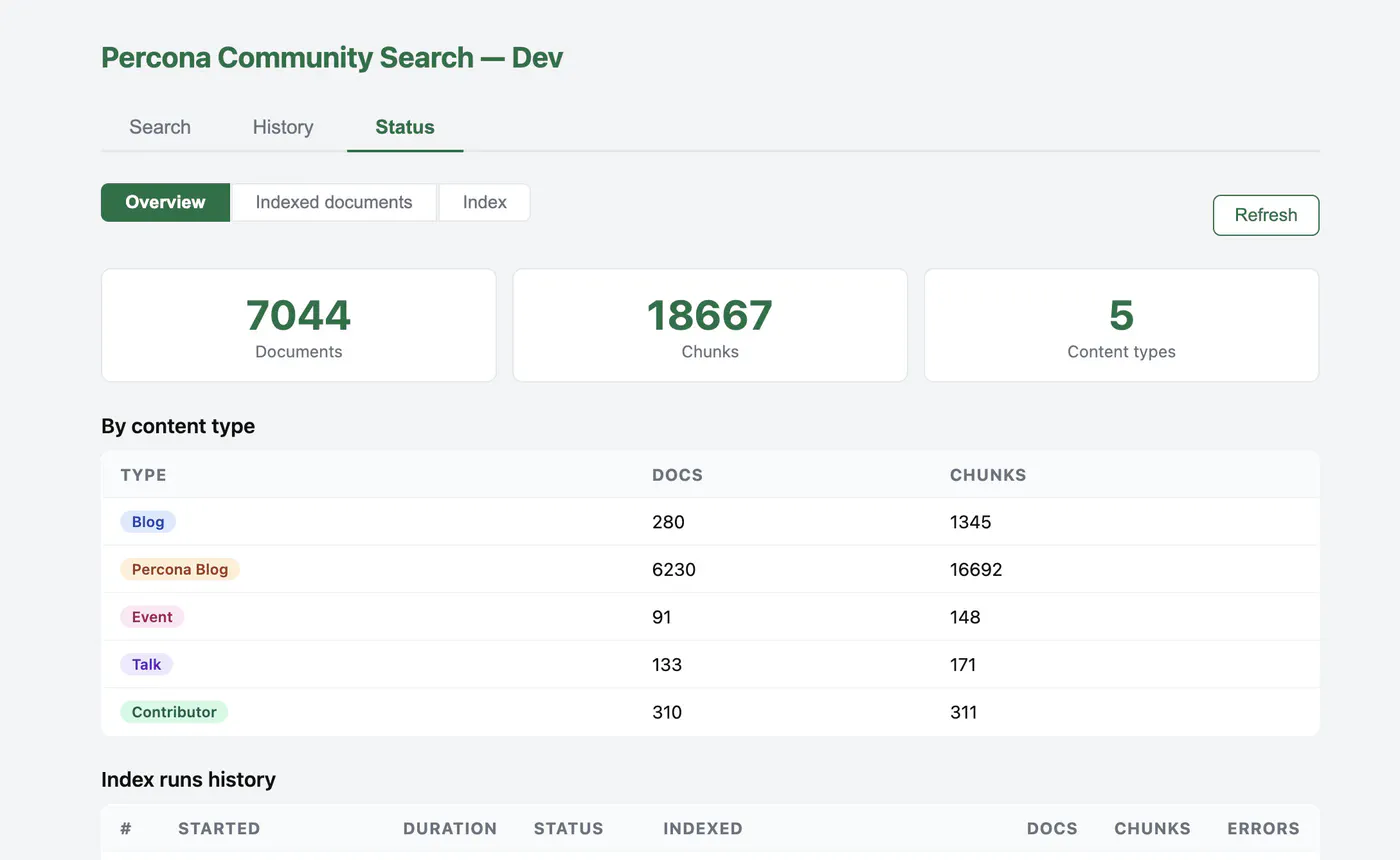
fetch_percona_blog_image()and apercona_blogbranch incrawler.py. - Scale. Roughly 6200+ new documents. The index went from about 800 to about 7000 pages and 18,000 chunks. HNSW on a single Postgres on EC2 still copes, but a full re-index takes hours, not minutes.
Indexer after crashes
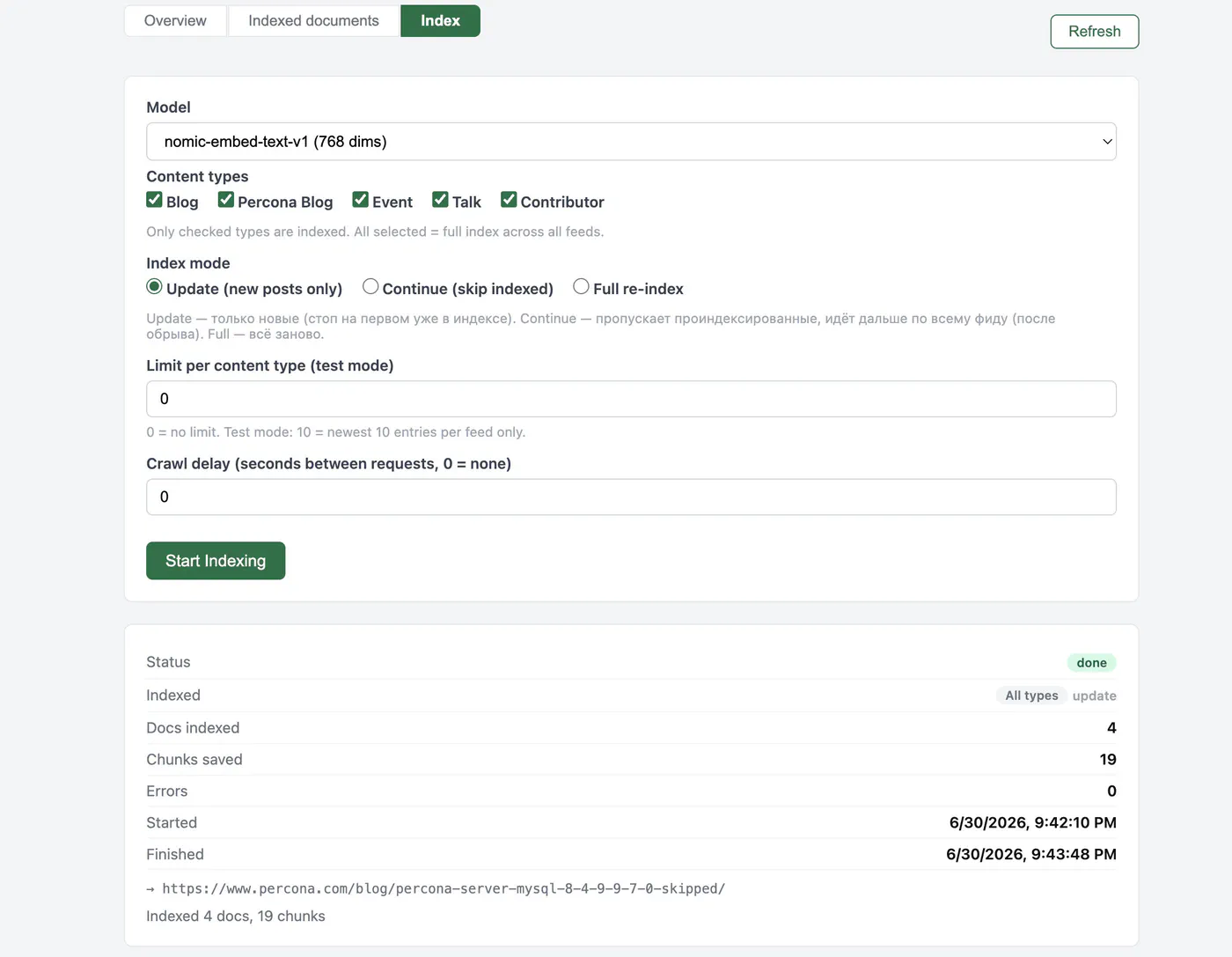
The first full Percona Blog crawl failed several times. Worker OOM, Docker restarts, a long RSS walk. I hardened the indexer:
| Problem | Fix |
|---|---|
| Re-crawl from scratch after a crash | skip_known, skip URLs already in pages |
| Resume mid-RSS | start feed page near indexed_count // 10 |
| Cancel did not work | cancel_requested checks between RSS pages, before fetch and encode |
| OOM during embedding | EMBED_BATCH_SIZE=8, batched model.encode() |
| No visibility | progress_log on indexer_runs, live log in demo |
| Stuck task after kill | on worker startup honour cancel, re-queue resume tasks |
Same worker and index_queue, but behavior closer to production ETL than a one-off script.
What’s next
- PostgreSQL FTS instead of bare ILIKE for the keyword leg
- Pagination on
/search/if I need to go past 30. Nobody needs all 900 author posts on one screen, “load 30 more” is enough - More sources from the Part 1 roadmap: video, GitHub, forum
Try it yourself
Popup search is in the percona.community header. Full results are at percona.community/search/.
Examples to try. These are demos of different modes, not a top from the log.
| Query | Mode | What to check |
|---|---|---|
zero downtime database migration | semantic | long phrase, vector-only |
replication lag troubleshooting | semantic | same |
pgbackrest | keyword | one-word product, hybrid |
Peter Zaitsev | person | contributor plus author articles |
best pizza recipe napoli | semantic | off-topic, empty above min_score |
As in Part 1, I am not publishing the search service code. It is built for percona.community. These posts share observations and ideas you can adapt. Vector search schema and SQL are in Part 2. The database is open-source Percona Distribution for PostgreSQL.
If you are building something similar or hit an edge case, leave a comment. In Part 1 I asked for feedback and it led to this post. ∎




Discussion
We invite you to our forum for discussion. You are welcome to use the widget below.